/
Integration, Anypoint Platform, API-led connectivity, and your first running Mule application — in one sitting.
Welcome to the first chapter of MuleSoft from Zero to Hero. By the end of this series you’ll design, build, deploy, and operate sophisticated integrations like a seasoned architect — but before writing a single line of code, we need to lay the conceptual foundation everything else builds on.
In this chapter we answer four questions every MuleSoft developer needs to internalize:
- Why do enterprises need integration in the first place?
- What is MuleSoft, and how does Anypoint Platform fit together?
- What is API-led connectivity — and why does it matter?
- How do you build and run your very first Mule application?
01 · The Problem — The Integration Challenge
Imagine you work for a fast-growing e-commerce company. Salesforce CRM holds the sales data. SAP ERP owns inventory and orders. A MySQL database stores user profiles. A mobile app communicates over REST/JSON. A web store needs all of it, in real time.
Each system speaks its own language and lives in a different place — on-premises or in the cloud. Some use SOAP, others REST, some expose no API at all and only allow file-based batch imports. To give customers a seamless experience — real-time inventory when they add to cart — these systems must talk to each other. That’s integration.
The Spaghetti Problem
Point-to-point integration (system A calls system B directly) creates a maintenance nightmare. With N systems you need N×(N−1)/2 custom connectors:
| Systems (N) | Point-to-Point connections | Hub-and-spoke |
|---|---|---|
| 5 | 10 | 5 |
| 10 | 45 | 10 |
| 20 | 190 | 20 |
| 50 | 1,225 | 50 |
Every schema change in Salesforce breaks all nine connections that touch it. Security, monitoring, and versioning become impossible to enforce globally. This is why enterprises accumulate integration debt that costs millions to repay.
02 · The Platform — What is MuleSoft?
MuleSoft — now part of Salesforce — provides a unified platform to connect applications, data, and devices, both in the cloud and on-premises. At its heart is the Mule runtime engine: a lightweight Java-based integration engine that processes messages through configured flows.
Anypoint Platform is a unified solution for iPaaS and full-lifecycle API management that lets you securely develop, deploy, and manage simple-to-complex APIs and integrations at scale, in one platform. It enables delivery 5× faster with reuse versus custom code.
— Salesforce / MuleSoft product pageInstead of building custom glue code for every connection, MuleSoft gives you:
- Pre-built connectors — Salesforce, SAP, Oracle, AWS S3, HTTP, Database, JMS, Slack, Workday, and 1,000+ more on Anypoint Exchange
- A graphical IDE (Anypoint Studio) to design integrations as visual flows
- DataWeave — MuleSoft’s expression and transformation language
- Centralized governance — policies, monitoring, and security applied consistently across every API
MuleSoft replaces custom point-to-point glue code with a centralized, governed, and observable integration hub. One platform to connect them all — while remaining decoupled so each system can change independently.
03 · The Toolkit — Anypoint Platform — The Complete Stack
The platform splits cleanly into two planes: a control plane (design, manage, monitor) and a runtime plane (where your integrations actually run). This separation lets you deploy the runtime in a MuleSoft-managed cloud, your own cloud, or fully on-premises — without changing how you build, govern, or observe.
Control Plane Components
| Component | What it does | You’ll meet it in |
|---|---|---|
| Design Center | Design APIs in RAML or OAS 3.0 with built-in mocking | Chapter 5A & 5B |
| Anypoint Exchange | Share & discover connectors, API specs, templates | Throughout |
| Anypoint Studio | Eclipse-based IDE — build flows graphically | Chapters 2, 3, 4, 6 |
| API Manager | Policies, SLA tiers, OAuth, rate limiting | Chapter 7 |
| Runtime Manager | Deploy & manage Mule apps across environments | Chapter 7 |
| Anypoint Monitoring | Dashboards, alerts, log search, AI diagnostics | Chapter 7 |
| Flex Gateway | Ultra-fast Rust gateway for any HTTP backend | Chapter 7 |
| CloudHub 2.0 | Managed containerised runtime, 12 global regions | Chapter 7 |
04 · The Pattern — API-Led Connectivity
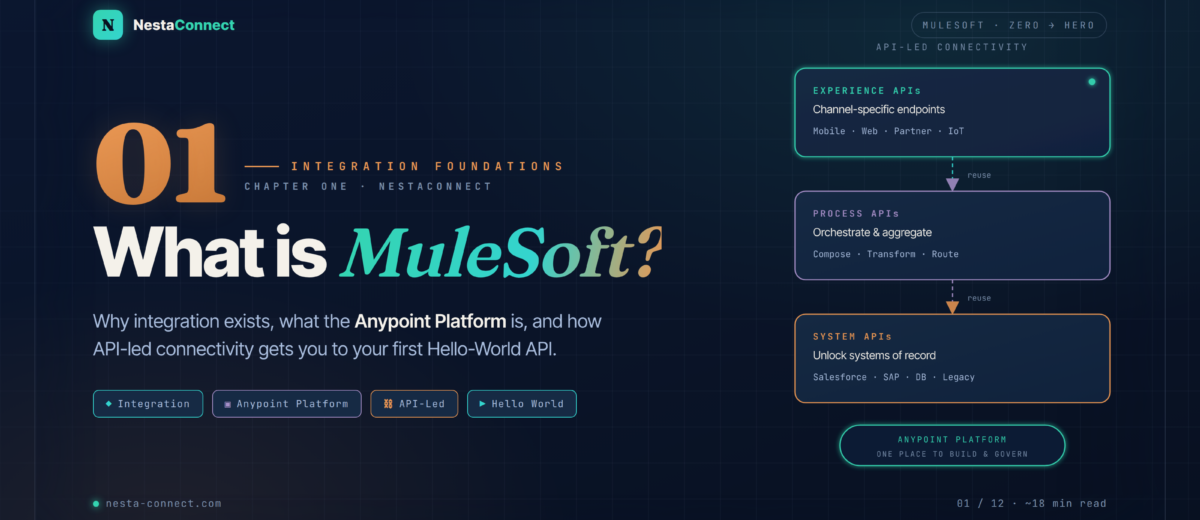
MuleSoft promotes an architectural pattern called API-led connectivity — a methodical way to connect data to applications through reusable and purposeful APIs. Instead of connecting systems directly, you organise APIs into three distinct layers, each with a single, clear responsibility.
On average, MuleSoft customers found that the agility and speed provided by API-led connectivity led to delivering projects 3–5× faster and increased team productivity by 300%.
— Salesforce BlogThe Three Layers
Real-World Example — Retail Customer 360
- The Salesforce System API wraps complex SOAP calls and exposes a simple
GET /salesforce/customers/{id}endpoint. - The Customer 360 Process API calls Salesforce, SAP, and MySQL System APIs in parallel via Scatter-Gather, merges the results, and returns a unified customer profile.
- The Mobile Experience API calls the Customer 360 Process API but strips the payload down to only what the mobile app needs — saving bandwidth and battery.
- A Partner Experience API reuses the same Customer 360 Process API but returns a richer, differently-shaped response for B2B partners.
When Salesforce migrates from API v45 to v50, only the Salesforce System API changes. The 12 apps consuming it see zero disruption. That’s the power of API-led — reusable, isolated, governed layers that absorb change.
05 · The Build — Build Your First Mule Application
Theory is great, but nothing beats running code. We’re going to build a real HTTP API that accepts a name query parameter and returns a JSON greeting.
5.1 Install Anypoint Studio
Download Anypoint Studio — the 30-day trial is free, no credit card required.
Windows, macOS, or Linux · Java 17 (OpenJDK recommended) · 8 GB RAM minimum. Studio ships with an embedded Mule 4.6 LTS runtime. Detailed instructions: official installation guide.
5.2 Create a New Mule Project
Go to File → New → Mule Project and configure:
- Name:
hello-world-api - Runtime: Mule Server 4.9 (LTS)
- Leave everything else as default → click Finish
Studio generates the project scaffold with hello-world-api.xml already open on the canvas.
5.3 Build the Flow
From the Mule Palette, search for and drag these three components onto the canvas, in order:
5.4 Configure the HTTP Listener
Double-click the HTTP Listener and set:
- Click + next to “Connector configuration” → Host:
0.0.0.0· Port:8081→ Test Connection → OK - Path:
/hello - Allowed Methods:
GET
5.5 Configure Set Payload with DataWeave
Double-click Set Payload, click the fx button, and enter:
%dw 2.0
output application/json
---
{
  message: "Hello, " ++ (attributes.queryParams.name default "World") ++ "!"
}
Set MIME Type to application/json. Breaking down the expression:
attributes.queryParams.name— reads the?name=query parameter from the HTTP requestdefault "World"— ifnameis missing, fall back to"World"++— the DataWeave string-concatenation operator
5.6 Configure the Logger
Double-click Logger and set Message to #[payload] and Level to INFO. This prints the response payload to the Studio console on every request — invaluable for debugging.
5.7 Run the Application
Save the file (Ctrl+S / Cmd+S), right-click your project in Package Explorer, then Run As → Mule Application. Watch the Console tab — within a few seconds you should see:
INFO  Starting app 'hello-world-api'...
INFO  Mule is up and kicking (every 5000ms)
INFO  Listening on 0.0.0.0:8081
5.8 Test Your API
From a terminal:
# With name parameter
curl http://localhost:8081/hello?name=Maria

# Default (no name)
curl http://localhost:8081/hello
Expected responses:
{ "message": "Hello, Maria!" }
{ "message": "Hello, World!" }
06 · The Mechanics — What Happened Under the Hood
When you hit GET /hello?name=Maria, Mule executed this exact sequence:
| Step | Component | What happened |
|---|---|---|
| 1 | HTTP Listener | Received GET /hello?name=Maria · Created a Mule Event with payload=null and attributes.queryParams.name = "Maria" |
| 2 | Set Payload | Evaluated the DataWeave expression · Output: {"message":"Hello, Maria!"} with MIME type application/json |
| 3 | Logger + Listener | Printed payload to console · Auto-sent 200 OK with Content-Type: application/json |
Here’s the complete XML Studio generates behind the scenes (visible via the Source tab):
<http:listener-config name="HTTP_Listener_config"
  doc:name="HTTP Listener config">
  <http:listener-connection host="0.0.0.0" port="8081" />
</http:listener-config>

<flow name="hello-world-apiFlow">
  <http:listener config-ref="HTTP_Listener_config"
    path="/hello" allowedMethods="GET"
    doc:name="Listener" />
  <set-payload value='#[%dw 2.0 ...]' />
  <logger level="INFO"
    message="#[payload]" />
</flow>
You can work entirely graphically and never touch XML — Studio keeps both in sync. But knowing the XML matters when debugging, comparing with documentation, or working in version control. Fluency in both views is the mark of a professional MuleSoft developer.
07 · Recap — Chapter Summary
You’ve covered a lot of ground. Here are the four ideas to carry into Chapter 2:
Integration debt scales as N²
Point-to-point connections grow quadratically with system count. Every schema change cascades.
- Different protocols, different homes
- Connections break on every change
- Security uneven across endpoints
- MuleSoft = one hub, one model
Anypoint splits cleanly
A control plane to design, manage, and monitor — and a runtime plane wherever you need execution.
- Design · Exchange · Studio
- API & Runtime managers
- CloudHub 2.0 · Fabric · on-prem
- 1,000+ connectors on Exchange
Three API layers absorb change
System APIs unlock data. Process APIs orchestrate. Experience APIs tailor. Reuse compounds.
- System — wrap legacy & SaaS
- Process — composition & logic
- Experience — shape per consumer
- 3–5× faster delivery (Salesforce)
Three components, one running API
Listener → Set Payload → Logger. You wrote DataWeave, exposed an HTTP endpoint, tested it with curl.
- HTTP Listener on port 8081
- DataWeave reads query params
defaultfor safe fallback- Logger streams to console