
All Articles

MuleSoft Mastery: From Zero to Hero | Ch.15
Governance flags problems; a custom policy fixes them at runtime. This complete, step-by-step guide builds a Mule Gateway policy from an empty folder to a published asset — configuring the Maven archetype, writing logic in template.xml around execute-next, defining the API Manager config UI in YAML, transforming requests and responses with the HTTP Policy Transform Extension, and rolling it out fleet-wide with Automated Policies. Includes the Treblle observability policy as a real-world example.
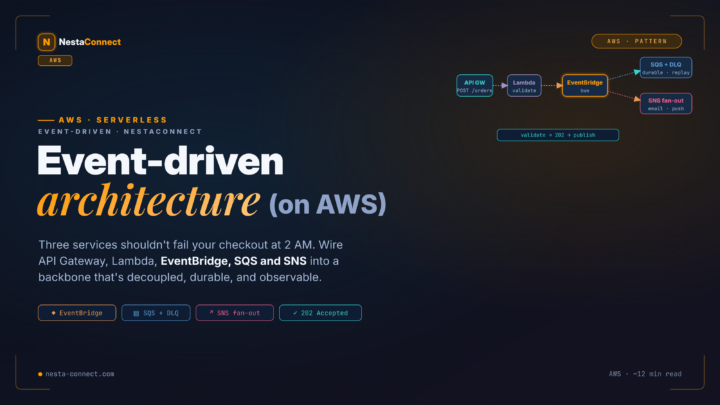
Event-Driven AWS Integration: API Gateway, Lambda, and Beyond
Learn how to wire API Gateway, Lambda, EventBridge, SQS, and SNS into a cohesive event-driven architecture that handles failures, ordering, and fan-out without glue code nightmares.
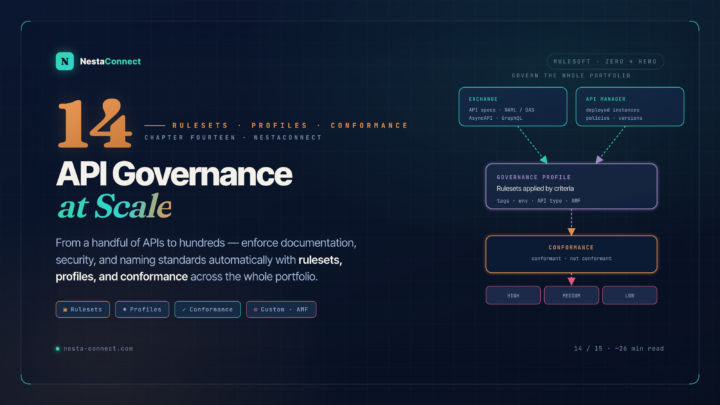
MuleSoft Mastery: From Zero to Hero | Ch.14
How Anypoint API Governance enforces consistency, security, and compliance across a whole API portfolio: reading the governance dashboard and conformance severity, applying MuleSoft-provided rulesets (built on AMF), targeting APIs with profiles and selection criteria, remediating nonconformance, and authoring, validating, documenting, and publishing custom rulesets with the Anypoint CLI. Includes a PCI-compliance case study across 50+ APIs. Chapter 14 of MuleSoft from Zero to Hero.
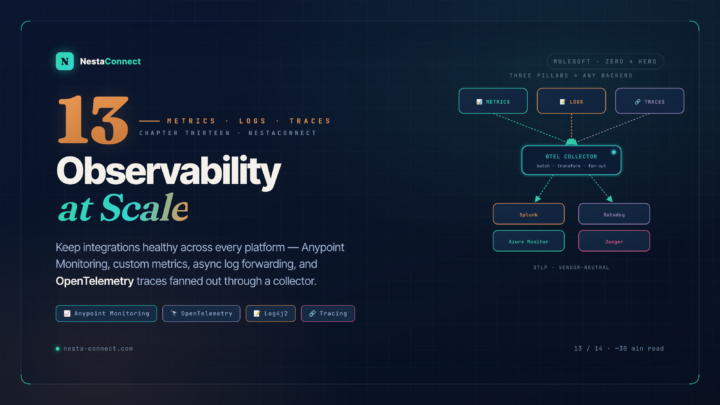
MuleSoft Mastery: From Zero to Hero | Ch.13
Observability for MuleSoft across the three pillars: Anypoint Monitoring dashboards and alerts, custom business metrics via the Custom Metrics connector (custom-metrics:send), log forwarding to Splunk, ELK and Azure with asynchronous Log4j2 appenders and MDC correlation, and distributed tracing with OpenTelemetry — the Direct Telemetry Stream (Mule 4.11+), W3C Trace Context propagation, and an OpenTelemetry Collector fan-out. Includes a payment-gateway troubleshooting case study across all three pillars. Chapter 13 of MuleSoft from Zero to Hero.
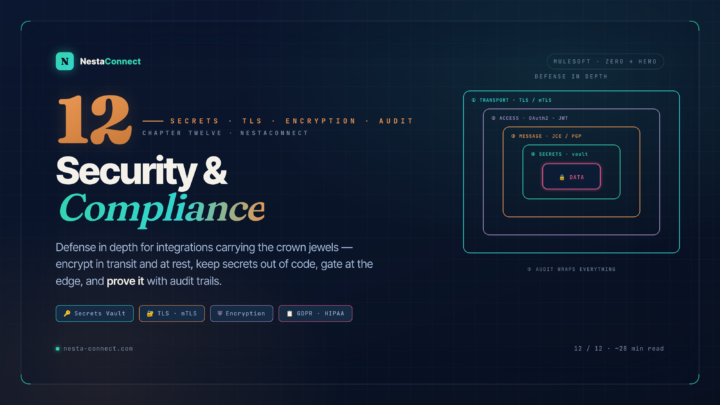
MuleSoft Mastery: From Zero to Hero | Ch.12
Defense-in-depth for MuleSoft integrations: TLS for data in transit, the Secure Configuration Properties module and external vaults for secrets, the Cryptography module (JCE and PGP) for message-level encryption, API Manager policies for access control, and the compliance practices — audit logging, data masking, and right-to-erasure — that satisfy GDPR, HIPAA and PCI-DSS. Includes a HIPAA-compliant patient-data API case study. Chapter 12 of MuleSoft from Zero to Hero.
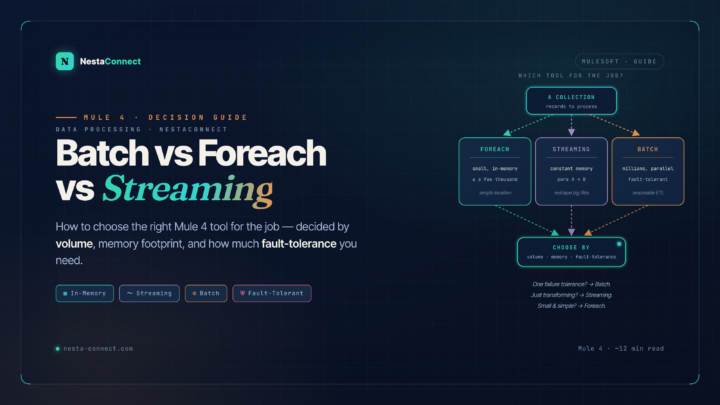
Mule 4: Batch vs Foreach vs Streaming — How to Choose
Mule 4 gives you three fundamentally different ways to process a collection — foreach/parallel-foreach, streaming DataWeave, and the Batch module. This guide is the decision in plain terms: choose by volume, fault-tolerance, and whether you need per-record error isolation, with the exact signals for each and the most common batch mistake to avoid.
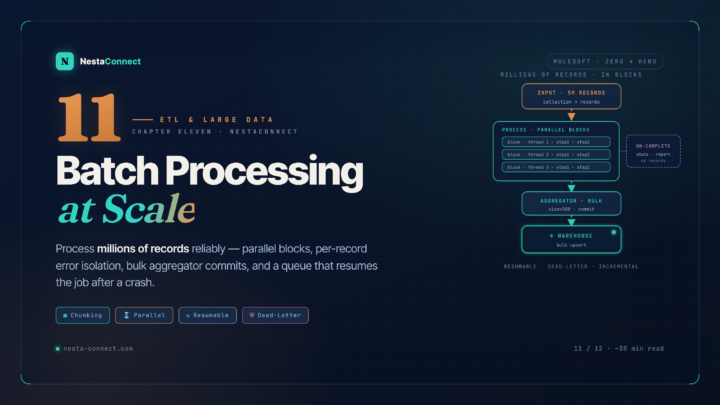
MuleSoft Mastery: From Zero to Hero | Ch.11
Process millions of records reliably with the Mule 4 Batch module. When to batch versus foreach or streaming, the three batch phases, batch steps with acceptExpression and acceptPolicy, the batch aggregator for bulk commits, maxConcurrency and blockSize tuning, automatic persistent-queue resumability, and a real 5-million-record SQL Server to Snowflake ETL migration with incremental load and a dead-letter table. Chapter 11 of MuleSoft from Zero to Hero.
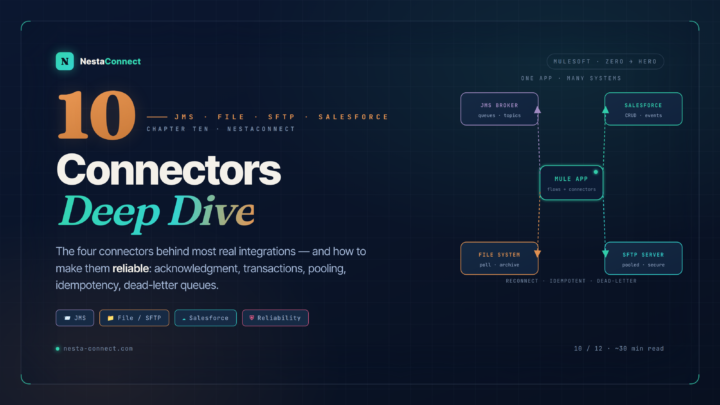
MuleSoft Mastery: From Zero to Hero | Ch.10
Master the four connectors that show up in almost every real integration: JMS for asynchronous messaging (queues, topics, acknowledgment, transactions), the File and FTP/SFTP connectors for reliable file movement with matchers and connection pooling, and the Salesforce connector for CRUD, SOQL, upsert, streaming events and Bulk API v2. Includes reliability patterns — reconnection, idempotent receivers, dead-letter queues — and a full SFTP-to-JMS-to-Salesforce order pipeline. Chapter 10 of MuleSoft from Zero to Hero.
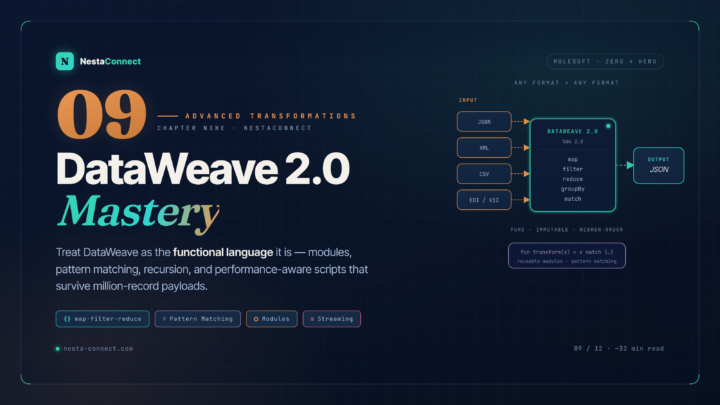
MuleSoft Mastery: From Zero to Hero | Ch.09
Go beyond simple mappings and treat DataWeave as the functional programming language it is. Objects, arrays, flatten and groupBy, reusable named functions and custom modules, pattern matching with type and regex cases, graceful error handling with try, performance with streaming and deferred output, a real EDI X12 850 to JSON case study, and unit-testing transformations with MUnit. Chapter 9 of MuleSoft from Zero to Hero.

MuleSoft Mastery: From Zero to Hero | Ch.08
Chapter 08 · MuleSoft from Zero to Hero Advanced Deployment & High Availability From a working API to a resilient, self-healing production platform — CloudHub 2.0 private spaces, Runtime Fabric…